


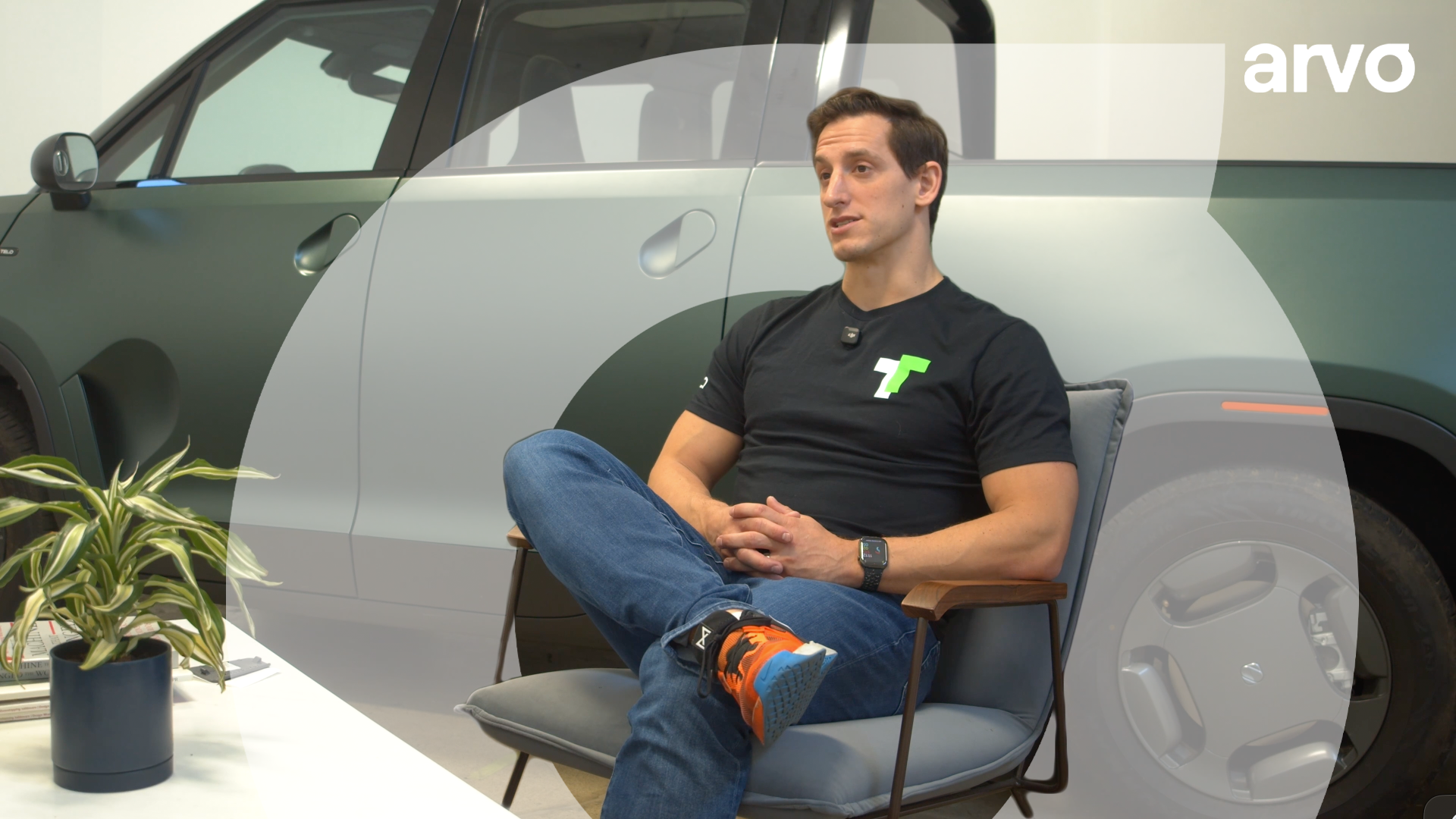
TELO Trucks is building the most capable truck in the smallest footprint: a fully electric, four-wheel-drive pickup sized like a Mini Cooper, with room for five adults and a five-foot bed. Led by CEO Jason Marks and co-founder and CTO Forrest North, the company set out to prove that a work truck doesn't need a full-size frame to deliver full-size capability — and that meant rethinking one of the auto industry's most settled engineering standards from the ground up.
The Challenge: Reinventing Crash Safety From First Principles
Modern crash safety has been developed iteratively for roughly 50 years, which is why nearly every truck on the road shares the same long-hood silhouette. TE LO Trucks needed to prove a compact pickup could match that safety bar without inheriting that design, and that meant years of dedicated engineering work.
- A legacy standard: Fifty years of iterative engineering built the conventional wisdom that crash safety requires a long hood and a full-size frame.
- A first-principles approach: TELO set out to solve for crash safety using physics fundamentals instead of convention — building a compact truck that's just as safe as the safest cars on the road, without the long hood.
- An extensive research lift: Proving that safety case took hundreds of thousands of hours of research and development.
- Real infrastructure costs: That kind of R&D isn't just headcount. It means machines, equipment, and dedicated engineering time — real costs for an early-stage vehicle manufacturer.
"We're dedicated to looking at a first-principles physics approach to crash safety. We don't have a long hood, but we're just as safe as the safest cars on the road."
— Jason Marks, Founder & CEO
The Solution: Partnering with Arvo
Rather than pulling engineers off the truck to decode the tax code, TELO turned to Arvo to manage the R&D tax credit process:
- Identifying qualifying work: TELO's crash-safety research and vehicle development work qualifies as research and development under IRS guidelines.
- Simplifying the process: Arvo handled the credit process from end-to-end, so TELO's engineers stayed focused on the truck, not the paperwork.
- Making the credit dependable: With Arvo managing the process, TELO could reliably count on capturing credits it had already earned through work it was doing anyway.
"Arvo is a great partner for TELO because they simplify the process of getting our R&D credits."
— Jason Marks, Founder & CEO
The Impact
- The equivalent of a new hire: Jason describes the credit as "basically like having the payroll for one to two extra engineers" — without adding headcount.
- Freedom to move faster: The credit lets TELO dedicate time and energy to its R&D program without having to worry about hiring someone new just to staff it — turning a tax incentive into effective engineering capacity.
- Room to bring on more people: Because the credit functions like freed-up headcount, TELO could bring more people onto the team and finish the work on the timeline it wanted, instead of stretching a smaller team thinner.
"It's basically like having the payroll for one to two extra engineers, and that's hugely valuable for startups. We'll probably build more value with those one or two people in this time period than the tax credit itself is worth."
— Forrest North, Co-Founder & CTO
Conclusion
TELO Trucks is proof that R&D doesn't always look like a lab coat and a clipboard. Sometimes it's a team of engineers asking why a truck has to look and behave the way it always has.
By partnering with Arvo to capture the credits that work had already earned, TELO turned a tax incentive into real engineering capacity, freeing Jason, Forrest, and their team to keep building the case that a smaller footprint doesn't have to mean a smaller truck.