


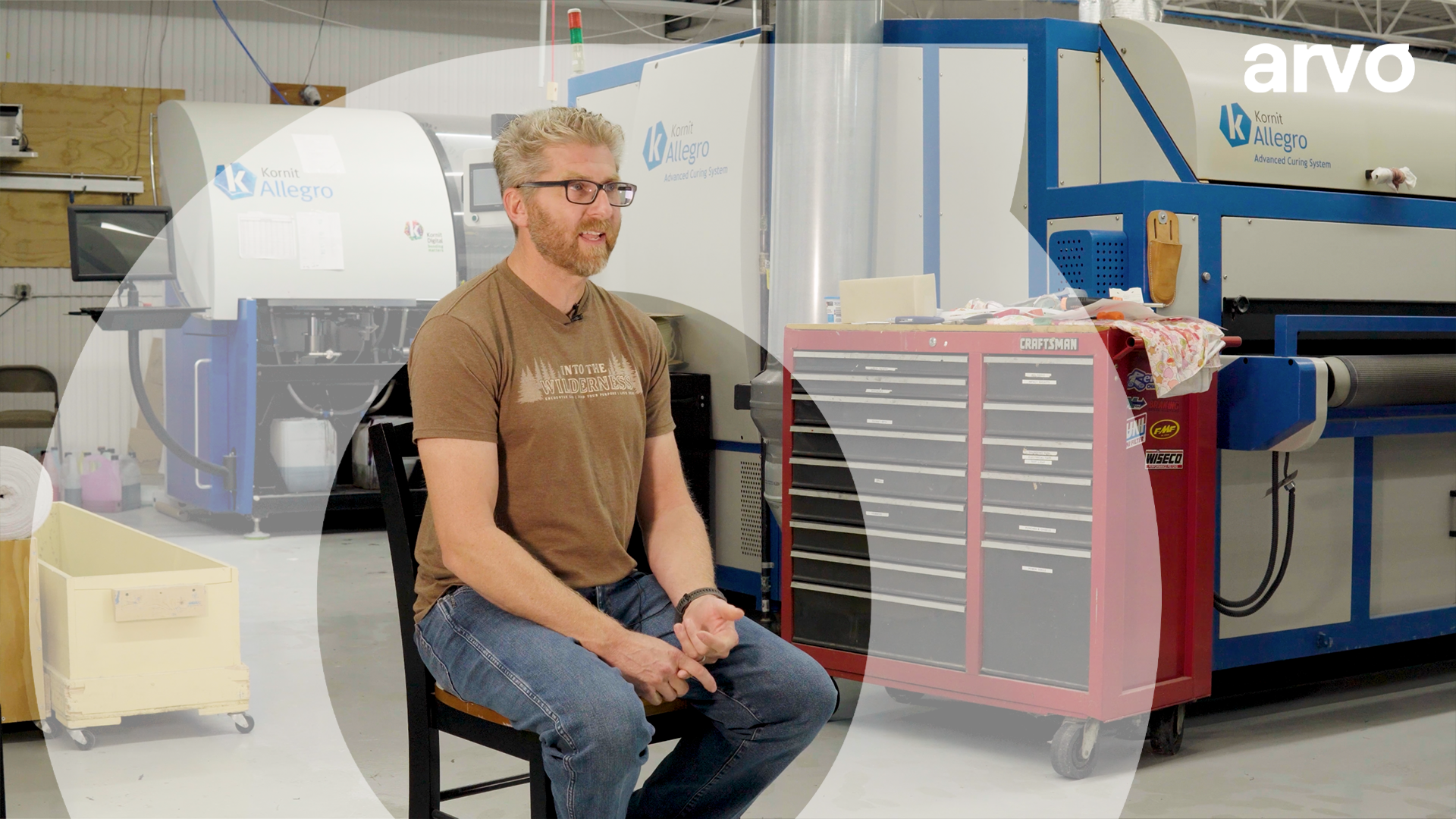
Carriage House Printery is one of the very few companies still manufacturing textiles end-to-end in the United States — with the ability to print, cut, and sew all under one roof. The company prints fabric and either sells it directly, cuts and sells it, or turns it all the way into finished products ranging from sporting goods to nearly anything a customer can imagine. It's owned by Shannon Frankhauser and run alongside her husband, Michael, who describes the early days of the business the way a lot of founders would recognize: wearing every hat at once.
The Evolution of Carriage House Printery
- 2018: Carriage House Printery gets its start as a US-based fabric printing and manufacturing operation — a rare shop that can print, cut, and sew in-house.
- Rapid growth: The company scales to multiple millions in annual revenue and builds out a deep set of operating systems to keep pace.
- A gap opens up: The business grows faster than its books. Financial records fall behind the operation they're supposed to track — and that gap starts causing real problems.
The Challenge: A Business That Outgrew Its Books
Carriage House Printery didn't have a growth problem. It had a books problem. As the company scaled into a multi-million-dollar operation, its financial records never kept up — and a string of bookkeepers made things worse instead of better.
- Growth outpaced the books: A fast-growing manufacturer with lots of moving operating systems was running on financial records that had fallen dangerously behind.
- A cycle of broken trust: Michael cycled through multiple bookkeepers who over-promised and under-delivered. By the time he realized a hire wasn't working out, the damage was already done — so he'd let them go, bring in someone new, and watch it happen all over again.
- Real damage, not just sloppiness: One bookkeeper decided the best approach was to run two separate sets of books. Others took it upon themselves to move money between accounts — decisions well outside their role.
- The cost of flying blind: As Michael puts it, bad books create three problems at once. You're flying a plane you can't read the dashboard on. You can't raise capital, because banks want to see clean books. And you can't file your taxes — which the government tends to notice.
- The founder as babysitter: Instead of running the company, Michael was spending his time babysitting people who weren't doing their jobs.
Our books were a complete dumpster fire. We had multiple bookkeepers who promised us the moon and didn't deliver. I trusted them, and by the time I realized I shouldn't have, it was too late"
— Michael Frankhauser, Co-Owner, Carriage House Printery
The Solution: Partnering with Arvo
Michael has a simple test for a bookkeeper: are they accurate, and are they on time? For years, the answer was no. When Carriage House Printery brought in Arvo, that changed.
- The right partner at the right stage: Michael's rule of thumb is that you can't afford a bookkeeper when you start a business — but at some point, you can't afford not to have a good one. Carriage House Printery had hit exactly that point.
- Accurate and on time: Arvo delivers on the two things Michael actually measures — clean numbers, reported when they're supposed to be.
- Cleanup, then discovery: Arvo didn't just tidy up the books. It surfaced issues that previous bookkeepers — and even a previous accountant — had let slide, then worked with Michael to understand what happened and correct it.
- Full visibility: For the first time, Michael can log in and see exactly what's being done: the changes, the progress, the cleanliness of the books. No more calling a bookkeeper, hearing "I'm working on something," and finding nothing had moved.
You can't afford a bookkeeper when you start your business. At some point, you can't afford not to have a good one. That's when Arvo was a very good fit for us.
— Michael Frankhauser, Carriage House Printery
The Impact
With Arvo handling the books, Carriage House Printery got back the two things a growing manufacturer can't operate without: accurate financials and the founder's time.
- No skeletons in the closet: Arvo found and fixed legacy errors now, while they're small — instead of leaving them to resurface years down the road when the company is bigger and the stakes are higher.
- Time back to run the business: Michael stopped babysitting bookkeepers and got back to the job he's actually supposed to be doing — running the shop.
- Better decisions, less stress: With books he can see and trust, Michael can make better financial calls without the weight that came from not knowing where things stood.
- A stronger business — and a stronger marriage: Running a company with your spouse tests a relationship, and disorganized books, back taxes, and financial uncertainty only add to the strain. Getting the books in order relieved that pressure — and Carriage House Printery even saw sales climb, because Michael was building the business instead of babysitting the mess.
- A partner that has his back: When Michael makes a mistake, Arvo catches it in the books and flags it. He knows the work is getting done, and getting done properly.
We've actually seen an increase in sales, because I'm doing this instead of babysitting that mess.
— Michael Frankhauser, Carriage House Printery
Conclusion
Carriage House Printery is proof that clean books aren't just back-office housekeeping — they're the foundation that lets a founder actually run and grow a business. A rare US manufacturer that can print, cut, and sew under one roof had built a multi-million-dollar operation, but its books were holding it back and pulling its founder off the floor.
By partnering with Arvo, Carriage House Printery traded a cycle of over-promising bookkeepers for financial records it can see, trust, and act on — and gave Michael his time, his focus, and his peace of mind back.
The job is getting done, and it's getting done properly. So the value is high. I would absolutely recommend Arvo."
— Michael Frankhauser, Carriage House Printery